Horny Goat Weed In Alpha Erec: What The Only Human Absorption Study Found
Horny goat weed is one of the six named Alpha Erec ingredients, and it is the one this blog had not yet covered. Its story is not about whether a trial found an effect. It is about whether the compound the herb is famous for, icariin, ever shows up in a human bloodstream at all — and the one study that measured this directly found it did not.
- Only one controlled human study has measured horny goat weed’s compounds in blood: 58 post-menopausal women, 740 mg a day of Epimedium prenylflavonoid extract, for six weeks (Yong 2021).
- Icariin itself, the compound named on Alpha Erec’s ingredients page, came back below the detection limit in blood. What showed up instead were three of its breakdown products.
- The study measured bone markers, not sexual function, desire or circulation, and it did not enrol a single man.
- No per-gummy amount or extract type for horny goat weed has been published on this site, so even the 740 mg research dose cannot be set beside what is in one gummy.
Horny goat weed, Epimedium and icariin
Horny goat weed is the common English name for plants in the genus Epimedium, a group of roughly fifty species in the barberry family that also carries the names Xianlingpi, Barrenwort, Bishop’s Hat, Fairy Wings and Yin Yang Huo in different traditions. A 2011 review counted more than 260 compounds isolated from the genus, with a family of molecules called prenylflavonoids as the main constituents and the ones used to tell species apart (Ma 2011).
Icariin is the best known of these prenylflavonoids, and it is the compound Alpha Erec’s own ingredients page names when it describes horny goat weed’s role: “a traditional Chinese herb whose flavonoid, icariin, acts on PDE5 in laboratory work.” PDE5, phosphodiesterase type 5, is the same enzyme that prescription erectile-dysfunction medicines block. That single sentence is doing a lot of work, and this article unpacks it: what “laboratory work” means, and what happens to icariin once it is swallowed rather than pipetted onto cells.
The only controlled human study
Despite how widely Epimedium extracts are sold, controlled human research on them is thin. The one randomised, double-blind, placebo-controlled trial that measured its compounds in human blood was not built to test sexual performance. It was a safety and pharmacokinetics study aimed at post-menopausal bone health (Yong 2021).
Fifty-eight post-menopausal women, average age just under 58, took either 740 mg a day of a purified Epimedium prenylflavonoid extract or a matching placebo for six weeks. The researchers drew fasting blood at three weeks, at six weeks, and again two weeks after the women stopped taking it. Two things were measured: whether the extract was safe, and what its compounds looked like in blood over time, using a precise laboratory method called tandem mass spectrometry.
| What the study did | What it did not do |
|---|---|
| Who took part | 58 post-menopausal women, aged 57.9 years on average |
| Dose and duration | 740 mg a day of Epimedium prenylflavonoid extract, for 6 weeks |
| What was measured | Blood safety markers; bone-specific alkaline phosphatase; a bone-resorption protein called TRAF6; and blood levels of five Epimedium compounds |
| What was not measured | Sexual function, desire, testosterone, or any circulation outcome; no men were enrolled |
The safety half of the result was reassuring on its own terms: no serious side effects, and no change in liver, blood or kidney tests over six weeks. That is worth knowing. It is the pharmacokinetic half, what actually turned up in the women’s blood, that changes how the “icariin acts on PDE5” sentence should be read.
What showed up in blood, and what did not
The researchers looked for five related compounds in the women’s serum: icariin, icariside I, icariside II, icaritin and desmethylicaritin. Only three of the five were found. Icariin, the compound named on Alpha Erec’s own ingredients page, and icariside I, were both below the limit the mass spectrometer could detect.
What the machine did find was desmethylicaritin, icaritin and icariside II — three compounds one step or more removed from icariin itself. Desmethylicaritin was the main one, reaching a median peak concentration of about 61 nanomoles per litre. None of this appeared in the placebo group’s blood at all, which confirms the extract was genuinely absorbed and processed. What it was not, once it reached the bloodstream, was icariin.
“Icariin and icariside I were below detection levels.”
Yong et al., Phytomedicine, 2021This is not a contradiction of chemistry so much as an ordinary feature of how the body handles plant glycosides. Icariin, as it exists in the dried herb or a raw extract, is not necessarily the same molecule that ends up doing anything once it is swallowed, digested and passed through the liver. In this study, it was the breakdown products that circulated, at measurable concentrations, while the parent compound did not.
The laboratory PDE5 story
The claim that icariin “acts on PDE5” comes from a different kind of research than the trial above. The 2011 review that Alpha Erec’s own pages cite for this point is a broad survey of Epimedium pharmacology, describing findings in cell cultures and animal models across a wide range of actions: hormone regulation, anti-osteoporosis effects, immune modulation, anti-oxidation, anti-ageing and more (Ma 2011).
Laboratory and animal work of this kind almost always uses purified icariin applied directly to cells, or dosed at levels and by routes that do not mirror a person swallowing a gummy. That is a reasonable way to discover what a molecule can do in principle. It is a separate question from what happens after a human digestive system finishes with it, which is exactly the gap the 2021 pharmacokinetic study was built to close for one specific dose, in one specific group.
Put the two studies side by side and a pattern appears: the PDE5 story rests on icariin acting directly on an enzyme in a dish or an animal. The one human study of an oral Epimedium extract found that icariin itself does not reliably reach the bloodstream at all. Whether the metabolites that do circulate, desmethylicaritin, icaritin and icariside II, carry any of the same PDE5 activity is a question the cited literature does not answer.
Why “horny goat weed” on a label is not one thing
Part of why this matters is that Epimedium supplements are sold in very different forms, and the form changes what actually goes into the capsule or gummy. A raw, dried and powdered herb, a basic alcohol extract, an extract standardised to a stated percentage of icariin, and isolated icariin powder are four different ingredients that can all be printed as “horny goat weed” on a label.
- 01
Check for an extract ratio
A ratio such as 10:1 means ten parts of raw herb were concentrated into one part of extract. No ratio listed usually means raw powder, which is the least concentrated form.
- 02
Check for a standardisation percentage
“Standardised to 10% icariin” tells you what fraction of the extract is the named compound. Without it, the icariin content of a given milligram amount is unknown.
- 03
Set the milligram amount beside the research dose
The one study measuring blood levels used 740 mg a day of a purified prenylflavonoid extract, not raw powder. A much smaller amount of raw herb is not the same exposure.
- 04
Notice when none of this is stated
Alpha Erec’s own pages name horny goat weed as an ingredient but do not publish a milligram amount or an extract type for it. That gap cannot be filled by this article; only the bottle’s own panel can answer it.
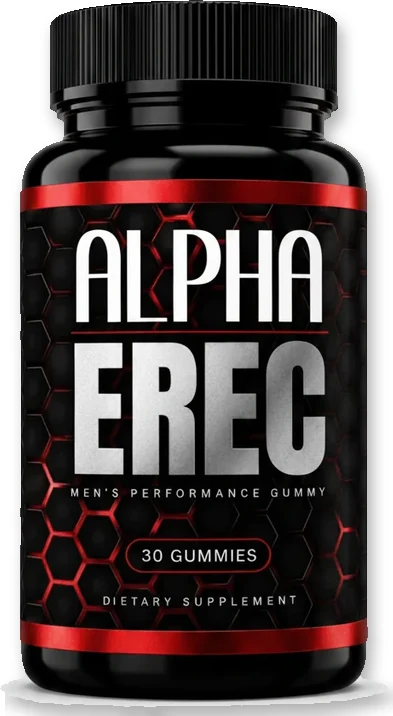
Order Alpha Erec: one gummy a day, six named ingredients
Horny goat weed is one of six named ingredients. The circulation line is carried by L-arginine and ginseng.
Packs of 2, 3 or 6 bottles · 60 days to change your mind
Choose Your Alpha Erec PackOne gummy a day, with or without food · ships from the United States
Safety notes
The 740 mg dose in the 2021 trial produced no reported adverse effects and no changes in liver, blood or kidney tests over six weeks, in post-menopausal women. That is a useful safety signal, though it was measured in a population and life stage that does not match the adult men Alpha Erec is sold to, and it says nothing about longer use.
Icariin is reported to act on the same enzyme family, PDE5, as prescription erectile-dysfunction medicines, in laboratory work rather than in a human trial. Anyone taking one of those prescriptions should ask the prescriber before adding horny goat weed in any form. The full interaction notes for every named ingredient are on the side-effects page.
Horny goat weed in Alpha Erec
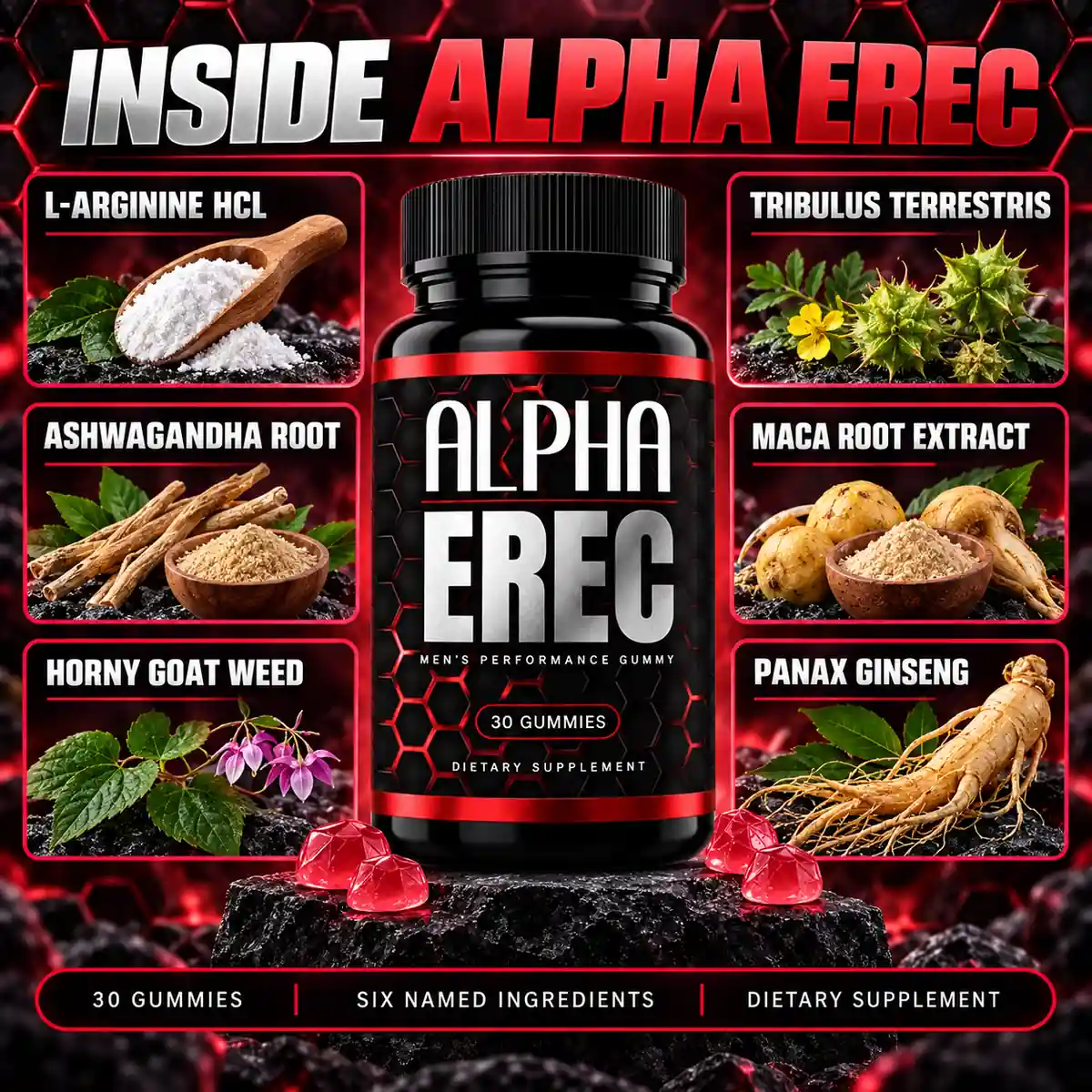
Horny goat weed is one of the six named Alpha Erec ingredients, alongside L-arginine HCl, ashwagandha root, tribulus terrestris, maca root extract and Panax ginseng. No milligram amount or extract type for it has been published on this site, so the one research dose that exists, 740 mg a day of a purified extract, cannot be compared with what one gummy actually contains.
The more useful reading is about what kind of evidence this ingredient rests on. It is not zero: a real, controlled, human pharmacokinetic study exists. But that study was not built around sexual performance, was not run in men, and found that the named active compound itself does not turn up in blood at a detectable level. The PDE5 story belongs to laboratory work on the purified compound, not to a study of anyone swallowing it. Every other named ingredient on the bottle has at least one trial that measured an outcome closer to what the gummy is sold for; horny goat weed, on the evidence available to this site, does not yet.
Questions buyers ask about horny goat weed
Does horny goat weed work for men’s performance?
No human trial measuring sexual performance, desire or circulation has been run with an Epimedium extract, to the sources this article draws on. The one controlled human study measured bone markers in post-menopausal women.
Is icariin actually absorbed when you eat it?
In the only study that measured this directly, icariin itself was below the detection limit in blood after six weeks of daily dosing. Three related compounds, its metabolites, were detected instead.
Can I take horny goat weed with a prescription ED medicine?
Ask the prescriber first. Icariin is reported to act on the same enzyme family as those medicines in laboratory work, which is a reason for caution even though it has not been tested in combination in a human trial.
The short answer
Horny goat weed brings a long traditional history and a real, if narrow, body of laboratory work to Alpha Erec’s formula. What it does not yet bring is a human study that measured sexual performance, or one that found its named active compound, icariin, actually circulating in blood after someone ate it. The one controlled human study that looked found the opposite: icariin below detection, its metabolites present instead, in post-menopausal women being checked for bone markers. That is a different, more modest claim than “acts on PDE5,” and it is the honest one. The label reading in every article on this blog, dose against research dose, is on the ingredients page.
Sources cited in this article
- Yong EL, Cheong WF, Huang Z, Thu WPP, Cazenave-Gassiot A, Seng KY, Logan S. Randomized, double-blind, placebo-controlled trial to examine the safety, pharmacokinetics and effects of Epimedium prenylflavonoids, on bone specific alkaline phosphatase and the osteoclast adaptor protein TRAF6 in post-menopausal women. Phytomedicine. 2021;91:153680. https://pubmed.ncbi.nlm.nih.gov/34352588/
- Ma H, He X, Yang Y, Li M, Hao D, Jia Z. The genus Epimedium: an ethnopharmacological and phytochemical review. J Ethnopharmacol. 2011;134(3):519-41. https://pubmed.ncbi.nlm.nih.gov/21215308/